
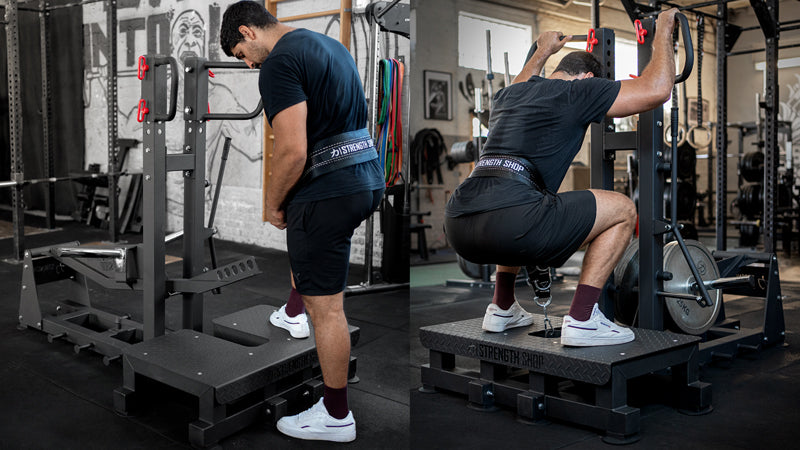
If you've been training legs seriously for any length of time, you know the feeling: your quads and glutes have more in them, but your lower back is done. Or your shoulder is flaring up and squatting with a bar on your back is off the table. Or you want to add another squat session to your week but the spinal loading from two barbell squat days is too much to recover from.
The belt squat solves all three of those problems at once — and that's before you even start talking about the training quality it delivers on its own terms.
This is not a machine for people who can't do barbell squats. It's a machine that trains the legs in a fundamentally different way from a barbell squat, with different advantages, different applications, and a place in virtually every serious lower body training program.
What Is a Belt Squat?
A belt squat is a plate-loaded machine where the resistance is attached to a belt around the hips rather than a barbell on the shoulders. You stand on an elevated platform, the weight hangs between your legs, and you squat. The spine carries no load. The upper body carries no load. The legs do all the work.
That sounds simple. The training effect is not.
When the load is applied at the hips instead of the shoulders, the biomechanics of the squat change significantly. The torso can stay more upright naturally. Knee tracking is easier to control. Depth — including full ass-to-grass depth — is more accessible to more athletes because the positional demands on the upper back and thoracic spine are removed. And because the lower back is not under compressive load, the limiting factor in the set is purely muscular rather than a combination of muscular and postural endurance.
The result: higher quality reps, deeper range of motion, and the ability to take the target muscles genuinely close to failure without compromising form or risking injury.
Who Should Be Training on a Belt Squat
Athletes with lower back issues or history of injury
The belt squat is one of the few leg training tools that genuinely removes spinal compression from the equation. Athletes managing disc issues, lower back strain, or chronic lumbar sensitivity can train the quads, hamstrings, and glutes at high intensity without loading the spine. This is not a compromise movement for injured athletes — it's often the movement that keeps training momentum going through periods when barbell squatting isn't possible.
Powerlifters and strength athletes managing volume
Heavy barbell squats accumulate spinal fatigue quickly. A powerlifter squatting three times per week has to manage not just muscular recovery but the cumulative stress on the spine, the hips, and the supporting structures. The belt squat allows leg training volume to increase without adding to that spinal load. Second squat session of the week on the belt squat machine: you get the quad and glute volume, the legs accumulate training stress, but the spine gets a session off from compressive load. For long-term training sustainability, this matters enormously.
Athletes with upper body injuries
Shoulder, wrist, elbow, or upper back injuries that prevent barbell back squatting don't prevent belt squatting. The upper body is entirely out of the load path. Athletes rehabbing rotator cuff issues, AC joint problems, or wrist injuries can maintain full lower body training intensity without aggravating the injury.
Beginners learning squat mechanics
The belt squat is technically simpler than the barbell back squat. Without a bar to balance, without upper back positioning to manage, and with the natural torso upright that hip-loaded squatting encourages, beginners can learn the squat pattern — depth, knee tracking, hip hinge, bracing — with less coordination demand and less injury risk. The form lessons learned on a belt squat transfer to barbell squats.
Bodybuilders and physique athletes
The belt squat is outstanding for hypertrophy because it allows deep, controlled reps where the quad and glute are under load through the full range of motion. Because form doesn't break down the way it can with a heavy barbell, sets can go closer to true muscular failure. This is where the machine earns its place in physique training specifically: it allows the kind of high-rep, deep-range work that produces leg development, without the systemic fatigue of heavy barbell squatting at the same volume.
Muscles Trained — and How Stance Changes the Stimulus
The belt squat's primary training effect is in the lower body. But the specific muscles emphasised shift significantly with stance width, foot angle, and depth.
Narrow stance (feet hip-width or closer, toes forward or slightly out)
- Primary: Quadriceps — all four heads, with emphasis on the rectus femoris and vastus lateralis
- Secondary: Glutes (less involved), adductors (inner thigh, stabilising role)
- Feel: More quad-dominant, more upright torso, deeper knee bend required for depth
- Best for: Quad development, learning squat mechanics, high-rep conditioning work
Shoulder-width stance (toes turned out 15–30°)
- Primary: Quadriceps and glutes in roughly equal proportion
- Secondary: Hamstrings (especially at depth), adductors
- Feel: Balanced, natural, most athletes' strongest position
- Best for: General lower body strength and hypertrophy, primary working position
Wide stance / sumo (feet outside shoulder width, toes turned out significantly)
- Primary: Glutes, adductors, inner quads
- Secondary: Hamstrings, hip external rotators
- Feel: More hip-dominant, less knee travel, glute activation higher at the bottom
- Best for: Glute development, hip mobility work, variety
Heels elevated (plates or wedge under heels)
- Primary: Quadriceps — increased quad activation across all stances
- Secondary: Reduces ankle mobility demand, allows deeper knee bend
- Feel: More forward knee travel, stronger quad sensation throughout
- Best for: Athletes with limited ankle mobility, quad-specific hypertrophy
Single-leg belt squat (one foot on platform, other hanging free)
- Primary: Quad, glute, and hamstring of the working leg — unilateral demand
- Secondary: Hip stabilisers, abductors, core
- Feel: Significantly harder than bilateral, addresses left-right imbalances
- Best for: Correcting asymmetries, unilateral leg development, rehab progression
The Strength Shop Belt Squat Range
Riot Belt Squat Machine
The Riot is the full commercial specification machine — built for high-frequency use, maximum load capacity, and the kind of training variety that makes it a permanent fixture in a facility rather than a specialist tool.
Load capacity: Tested to 525kg, rated to 750kg. This is not a number that needs qualification — it means the machine will never be the limiting factor in what an athlete can load.
Footplate: Large non-slip surface, 60.6cm × 106cm — wide enough to accommodate a variety of stance widths, including sumo and wide-stance variations, without the feet overhanging the edge. The elevated platform design allows full depth, including ass-to-grass squatting, without the weight hitting the floor.
The dip function — a genuine addition, not a gimmick. The handles on the Riot can be flipped upside down, converting the machine into a weighted dip station. For athletes who want to add load to dips — one of the most effective compound upper body pressing movements — the Riot provides a stable, well-positioned dip setup. This is particularly useful in setups where floor space is limited and adding a separate dip station isn't practical.
Handle adjustability: The angled handles adjust in angle and offer multiple grip positions, allowing the hold to match the athlete's shoulder width and preferred dip depth. Not one fixed position — several.
Belt attachment: Five different settings for belt attachment height at the machine. This matters more than it might seem — the height at which the belt connects affects the loading angle, hip position, and how the weight moves through the squat. Five positions means the setup can be dialled in for different athletes and different movement intentions.
Band pegs: Six band pegs for attaching resistance bands. Banded belt squats — where resistance increases at the top of the movement — are a well-established tool for developing explosive leg drive and accommodating resistance training. Six pegs means this is fully supported.
Lever arm: The lever arm allows controlled load management at the start and end of sets. For training close to failure at heavy loads, this is an important safety feature — it means the weight can be set down without requiring a spotter or a rack catch.
Dimensions: 204cm × 117.2cm × 160.5cm Machine weight: 200kg Loading pin diameter: 49mm — compatible with standard Olympic plates Loading pin length: 37.5cm Material: Black powder-coated steel Included: Belt and carabiner
Original Belt Squat Machine
The Original covers the fundamentals of belt squatting at a more accessible price point. It's built from 3mm powder-coated steel, rated to 300kg, and includes the essential features that make a belt squat machine work: elevated platform, hip-level belt attachment, support beam, and two weight storage sleeves.
The belt lever has two attachment settings — less adjustment range than the Riot's five positions, but sufficient for athletes at standard body proportions. The machine includes a thick Dacron polyester squat belt, built to handle the loads the machine is rated for.
At 85kg machine weight and smaller footprint dimensions (156cm × 122cm × 107cm), the Original is the more manageable option for home gyms and smaller facilities where space and weight of the unit itself are considerations.
What it doesn't have compared to the Riot:
- No dip function
- Two belt attachment settings rather than five
- 300kg max load vs 750kg
- No band pegs
- No lever arm for load control
- Smaller footplate
What it does have:
- Full belt squat functionality — the core movement, correctly executed
- 3mm steel construction built for durability
- Dacron belt included
- 50mm sleeve diameter for Olympic plate compatibility
- A lower entry point for athletes who want the benefits of belt squatting without the full commercial machine price
For a home gym where belt squatting is one tool among many, the Original is a straightforward, honest machine. For a commercial gym, a dedicated strength facility, or any setting where the machine will be used daily by multiple athletes at high loads, the Riot is the right investment.
Belt Squat vs Barbell Squat: Not Either/Or
The belt squat is not a replacement for the barbell squat. The barbell squat trains the upper back, core, and full-body stabilisation in a way the belt squat doesn't replicate. For powerlifters, the barbell squat is the competition lift and must be trained specifically. For most athletes, the barbell squat is the primary leg strength movement.
The belt squat's role is additive. It adds training volume that doesn't accumulate spinal fatigue. It adds training options when injuries limit barbell squatting. It adds hypertrophy work at ranges of motion and rep counts that are difficult to achieve safely with a barbell. It adds a beginner-accessible entry point to the squat pattern.
The two tools complement each other. Programmes that include both consistently produce better lower body development than programmes that include only one.
Training Plan: Integrating the Belt Squat
This is a four-week lower body programming block showing how to integrate the belt squat alongside barbell work. It covers strength, hypertrophy, and volume management.
Option A — Powerlifter / Strength Athlete
Goal: Maintain leg volume without accumulating excess spinal load
Day 1 — Main Squat (Barbell)
| Exercise | Sets | Reps | Notes |
|---|---|---|---|
| Back Squat | 5 | 3–5 | Main strength work, heavy |
| Romanian Deadlift | 3 | 6–8 | Posterior chain |
| Leg Press or Hack Squat | 3 | 10–12 | Volume work |
| Leg Curl | 3 | 10–12 | Hamstring isolation |
Day 2 — Belt Squat Session (2–3 days later)
| Exercise | Sets | Reps | Notes |
|---|---|---|---|
| Belt Squat | 4 | 8–12 | Shoulder-width stance, controlled depth |
| Belt Squat — Wide Stance | 3 | 10–15 | Glute emphasis |
| Single-Leg Belt Squat | 3 | 8–10/side | Unilateral balance |
| Weighted Dips (Riot only) | 3 | 8–10 | Upper body complement |
| Banded Belt Squat | 2 | 15–20 | Light bands, conditioning finish |
The belt squat session accumulates quad and glute volume. The spine gets a session off from compressive load.
Option B — Bodybuilder / Hypertrophy Focus
Goal: Maximum leg development, high volume, controlled fatigue
Push/Pull/Legs — Legs Day
| Exercise | Sets | Reps | Notes |
|---|---|---|---|
| Belt Squat — Narrow Stance | 4 | 10–15 | Quad focus, heels elevated optional |
| Belt Squat — Wide Stance | 3 | 12–15 | Glute and inner quad focus |
| Romanian Deadlift | 3 | 10–12 | Barbell or dumbbell |
| Leg Extension | 3 | 15–20 | Terminal quad isolation |
| Leg Curl | 3 | 12–15 | Hamstring balance |
| Calf Raises | 4 | 15–20 | Standing or seated |
Belt squat leads the session — it's the primary loading tool, not a finisher.
Option C — Rehab / Lower Back Management
Goal: Maintain leg training through a period of lower back sensitivity
Full lower body session, no spinal load:
| Exercise | Sets | Reps | Notes |
|---|---|---|---|
| Belt Squat | 4 | 12–15 | Comfortable depth, controlled tempo |
| Single-Leg Belt Squat | 3 | 8–10/side | Unilateral, light load |
| Hip Thrust (barbell or machine) | 3 | 12–15 | Glute loading without spinal compression |
| Leg Curl | 3 | 12–15 | Hamstring |
| Banded Walk / Monster Walk | 3 | 15/side | Hip abductor activation |
No barbell squats, no deadlifts, no Romanian deadlifts with heavy load. Full leg training stimulus with zero compressive spinal load.
Option D — Beginner / Learning the Squat Pattern
Twice per week:
| Exercise | Sets | Reps | Notes |
|---|---|---|---|
| Belt Squat — Bodyweight or Light | 3 | 15 | Learn depth and knee tracking |
| Belt Squat — Moderate Load | 3 | 10–12 | Add weight when form is solid |
| Goblet Squat | 2 | 12–15 | Pattern reinforcement |
| Romanian Deadlift (light) | 3 | 12 | Posterior chain introduction |
| Leg Press | 3 | 15 | Additional quad volume |
Add weight to the belt squat only when depth, knee position, and bracing are consistent.
The Short Version
The belt squat trains the legs without loading the spine. That single fact has more implications than it first appears. More training volume. More training options. More athletes who can train effectively. More reps taken to genuine muscular failure without form compromise.
It belongs in any training programme that takes lower body development seriously — whether the goal is strength, hypertrophy, rehabilitation, or athletic conditioning.
Riot Belt Squat Machine — up to 750kg, dip function, full commercial spec Original Belt Squat Machine — 300kg, essential features, home and small gym